
Massey Ferguson 135 Steering: Box, Pump, or Cylinder? Diagnose Before You Buy

If your Massey Ferguson 135 steering has gone hard, loose, or it's dropping oil on the ground, the fix is almost always one of three parts: the steering box, the power steering pump, or the steering cylinder (ram). The trick is figuring out which one before you buy. The most common mistake we see at the counter is a farmer replacing a good pump when the real problem was a leaking cylinder seal, or the other way around.

This guide walks you through isolating the failure the way a mechanic would, then points you to the right part once you know what you're chasing.
Quick Answer
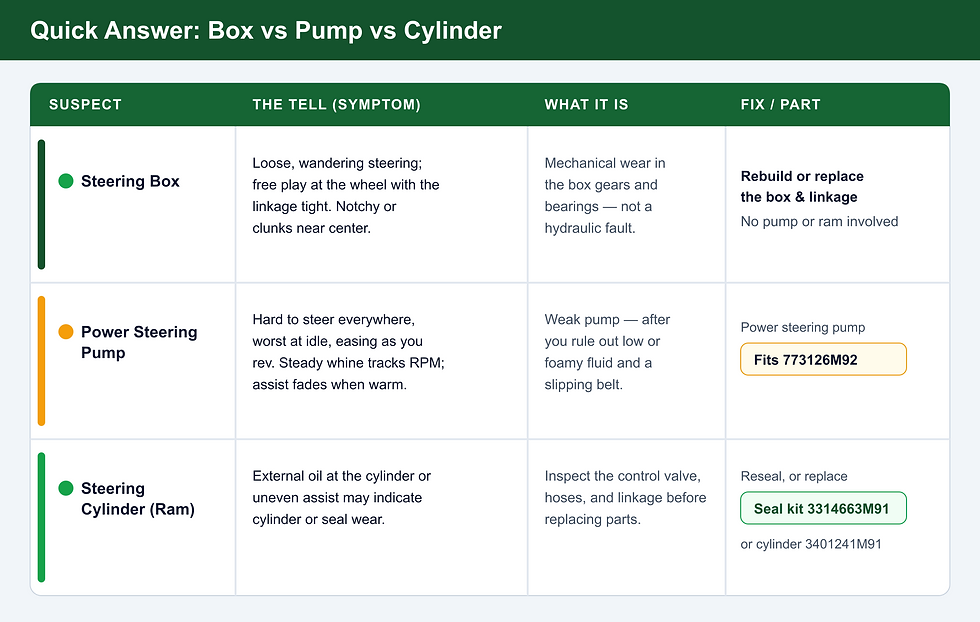
Hard to steer, pump whining, little or no assist → usually the power steering pump (or low/aerated fluid). Check the fluid first.
Loose or wandering steering may come from the steering gear, steering-shaft components, tie rods, drag link, kingpins, or other front-axle wear. Inspect the linkage before diagnosing the steering gear.
Oil film on the ram, drips under the front, or uneven assist → inspect the steering cylinder and its seals, along with the control valve, hoses, and linkage.
First, know which system you have. The MF135 was built with manual steering and with power steering. A manual-steering tractor has no pump or ram to blame, so don't order power steering parts for it.

Manual or Power Steering? Confirm Before Anything Else
Your MF135 left the factory one of two ways. Manual-steering tractors steer entirely through the steering box and linkage, with no hydraulic assist. Power-steering tractors add an engine-driven pump, a control valve, and a steering cylinder that does the muscle work at the front axle.
If steering is heavy but the tractor has no power steering pump or ram, the box and the front-end linkage are your whole story. If you do have power steering, you've got three suspects instead of one, and the checklist below is written for you.

Diagnose First: Box, Pump, or Cylinder?
Work cheap-to-expensive. Two minutes of checking can save you the price of the wrong part.
Step 1: The five-minute checks
Fluid level and condition. Low fluid or milky, foamy oil will make a healthy pump whine and steer like garbage. Foam means air or water is getting in; find that before you condemn the pump.
Look for leaks. A wet, oily film on the cylinder rod, a puddle under the front axle, or oil weeping at the pump shaft or a hose fitting all point you somewhere specific.
Belt and pulley. A glazed or loose belt to the pump can mimic a weak pump. Check tension before you buy anything.
Step 2: The wheels-up feel test
Chock the rears, safely jack the front axle so the tires clear the ground, and support it on stands. With the engine off, grab a front tire and rock it. Now turn the wheel lock to lock by hand. You're feeling for where the slop and effort live. This one test separates worn linkage from a bad box from a hydraulic problem.
Signs it's the steering box
Free play at the steering wheel — you can turn the wheel an inch or more before the front tires move — while the drag link and tie rods are tight.
Steering feels notchy, tight in spots, or clunks near center.
On a power tractor, the assist still works fine; it's the slop that bugs you. That's mechanical wear in the box gears and bearings, not a hydraulic fault.
Signs it's the power steering pump
Hard steering everywhere, worst at low idle, easing up as you rev the engine.
A steady whine or groan from the pump that tracks engine speed.
Assist that fades when the oil warms up. After checking the fluid, belt, hoses, linkage, and system condition, low pump pressure may indicate a worn pump. A pressure test is the best way to confirm pump output before replacement.
Signs it's the steering cylinder (ram)
An oily rod or a drip that always comes back to the cylinder, not the pump or a hose.
External oil around the cylinder rod may indicate worn cylinder seals. Uneven assist or steering drift can also involve the steering control valve, hoses, linkage, so these symptoms do not confirm a failed cylinder by themselves.
Assist that is stronger in one direction may involve the steering cylinder, control valve, hydraulic lines, or linkage. Inspect the complete system before replacing the cylinder.
Rule out plain mechanical wear
Before you spend on any hydraulic part, confirm the wander isn't just loose tie rod ends, worn king pins, or a sloppy drag link. With the front jacked up, a helper turns the wheel while you watch each joint. Movement at a joint before the wheel moves is your culprit. Fixing a $200 pump won't cure a worn tie rod end.
Which Part Do You Need? (By Symptom)
Once you've isolated the failure, here's where to find the part. On these tractors casting numbers matter, so confirm your part number or casting against your old unit before ordering. Several MF models share a family of steering parts with small differences, and the wrong casting means the wrong part on your bench.
No assist, whining, hard to steer → power steering pump. See the Massey Ferguson Power Steering Pump 135 240 (Fits 773126M92), a complete unit with reservoir. Match your OEM number before you buy — a few pump styles were used across this era.
External cylinder leak or uneven steering assist → steering cylinder (ram). Massey Ferguson Right-Hand Power Steering Cylinder replacing 3401241M91 for selected MF135 and related applications. Confirm the original cylinder number, mounting, hose fittings, and tractor configuration before ordering.
Cylinder leaks but the barrel and rod are still good → reseal it. If the cylinder rod and barrel are serviceable, seal kit 3314663M91 may repair certain compatible Massey Ferguson steering cylinders. Confirm the original cylinder number before ordering the seal kit.
Not sure yet, or need a related part? Browse the full Massey Ferguson & Perkins parts category (MF 135, 240, 265) to line up seals, pumps, and cylinders in one place.

MF135 Steering FAQ
Why is my MF135 suddenly hard to steer?
Start by checking the power steering fluid level and condition. Low or aerated fluid, a loose drive belt, restricted hoses, binding linkage, or worn front-axle components can all cause hard steering. If those checks are good and the pump is noisy or assist is weak, test the pump pressure before replacing it.
My steering wanders and feels loose — is that the pump?
Usually not. Loose or wandering steering is commonly caused by wear in the steering gear, tie-rod ends, drag link, kingpins, wheel bearings, or other linkage components. Inspect the complete front steering system before replacing the pump.
Can I just replace the cylinder seals instead of the whole ram?
Possibly. If the cylinder rod and barrel are smooth and undamaged and the correct seal kit is available, resealing may repair an external leak or internal bypass. Replace the complete cylinder if the rod is bent, scored, corroded, or if the cylinder bore is damaged. Confirm the original cylinder number before ordering a seal kit.
How do I tell a pump leak from a cylinder leak?
Clean the system and inspect it while operating the steering carefully. Oil appearing at the pump shaft, reservoir, or pump fittings points to the pump area. Oil on the cylinder rod or cylinder body points to the cylinder, while oil at a fitting may come from the hose or connection. Do not hold the steering against full lock longer than necessary because this raises hydraulic pressure and heat.
Will a power steering part fit my manual-steering 135?
Not as a direct replacement. A manual-steering MF135 does not use the same pump-and-cylinder assist system as a power-steering-equipped tractor. Converting a manual-steering tractor requires the correct complete system and compatible steering components—not simply one power steering part. Confirm the tractor's steering configuration before ordering.
Still Not Sure? We'll Match It
Steering trouble on a decades-old tractor is rarely mysterious once you isolate it, but the castings can be a maze. Send us the original part number or a clear photo, and we'll help match the power steering pump, cylinder, seal kit, or other parts we carry. We'll confirm the correct part for your MF135 before it ships.
— Arko Tractor Parts Team


Comments