
John Deere Tractor Hydraulics Weak or Won't Lift: What to Check Before Replacing the Pump

If your John Deere tractor lifts slow, won't hold a load, or won't pick up at all, start with the basics before you reach for a pump. Weak or no-lift hydraulics commonly result from low oil, restricted oil flow, pressure-control problems, internal leakage, or pump wear. Most of those cost far less than a pump. Work the hydraulic system in order, cheapest fix first, and most owners find the trouble before they ever reach the expensive parts. Here's how to check John Deere hydraulics the way a shop would, so you only buy a pump when it's actually the pump.

Quick Answer
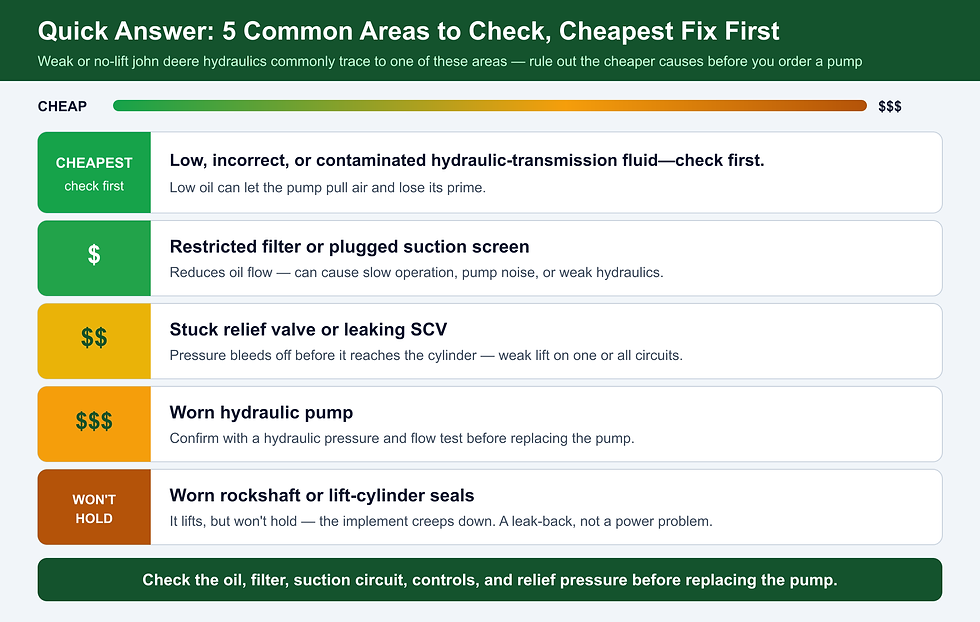
Weak or no-lift hydraulics on a John Deere tractor commonly trace back to one of these areas, listed cheapest to most expensive to address:
Low, incorrect, or contaminated hydraulic-transmission fluid — one of the first things to check when lift is slow or weak.
A restricted hydraulic filter or plugged suction screen — reduces oil flow and can cause slow operation, pump noise, or weak hydraulics.
A stuck relief valve or a leaking SCV — pressure bleeds off before it reaches the cylinder.
A worn hydraulic pump — confirm it with a hydraulic pressure and flow test before you replace anything.
Internal leakage at the rockshaft piston seals, control valve, check valve, SCV, or cylinder — it lifts, but won't hold, and the implement creeps down.
Don't order a pump until you've ruled out the cheaper causes. On many John Deere tractors the transmission and hydraulics share the same oil, so a fluid or filter problem shows up as weak lift.

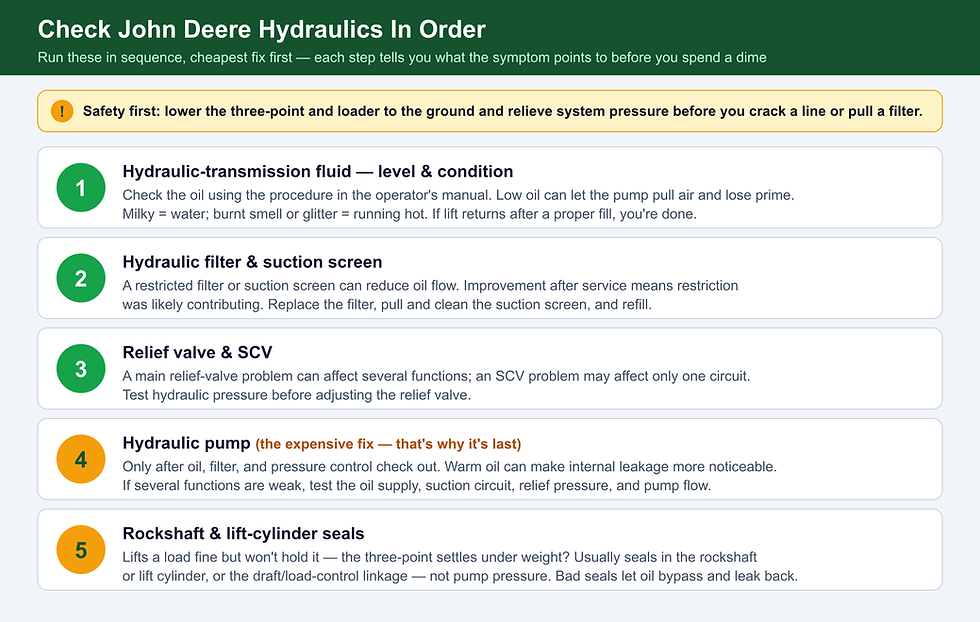
Check John Deere hydraulics in order
Run these in sequence. Each step tells you what the symptom points to before you spend a dime. One safety note first: lower the three-point and any loader to the ground and relieve system pressure before you crack a hydraulic line or pull a filter. Hydraulic oil under pressure is dangerous, and a raised implement can drop without warning.
Hydraulic-transmission fluid level and condition. Park on level ground, lower all implements, shut off the engine, and check the oil according to the operator's manual. Low fluid is one of the first things to check — the pump can pull air and lose its prime. Milky oil means water got in; a burnt smell or metal glitter means the system has been running hot or a part is wearing. Top off or change with the correct John Deere hydraulic/transmission oil and capacity from your operator's manual before you chase anything else. If lift comes back after a proper fill, you're done.
Hydraulic filter and suction screen. A restricted filter or suction screen can reduce oil flow and cause slow operation, pump noise, or weak hydraulics. This is common right after a fluid change that stirred up old sludge, or on a machine that has gone years between services. Replace the filter, pull and clean the suction screen, and refill. If performance improves after servicing the filter and screen, restricted oil flow was likely contributing to the problem.
Main relief valve. The main relief valve caps how much pressure the hydraulics build. If it sticks open or its spring is weak, pressure bleeds off, and because it sits in the shared pressure circuit a main relief-valve problem can affect several hydraulic functions at once. Test hydraulic pressure before adjusting or replacing the relief valve.
Selective control valve (SCV). An SCV problem may affect only one circuit, so the symptom usually shows up on a single function — one implement drifts down, or the loader settles — while the rest of the hydraulics work normally. If lift is weak on one function but fine on another, look at that circuit's valve, couplers, hoses, and cylinder rather than the pump.
Hydraulic pump. Only after oil, filter, and pressure control check out do you suspect the pump. Warm oil can make internal leakage from a worn pump more noticeable, so lift may fall off once the machine heats up. If several hydraulic functions are weak, inspect the shared oil supply, suction circuit, pressure circuit, relief valve, and pump. Hydraulic pressure and flow should be tested before replacing the pump — this is the expensive fix, which is exactly why it's last on the list.
Rockshaft, control valve, and lift-cylinder seals. If the tractor lifts a load fine but won't hold it — the three-point slowly settles under weight — the trouble is usually internal leakage at the rockshaft piston seals, control valve, check valve, SCV, or attached cylinder, or a draft/load-control problem, not pump pressure. Internal leakage lets oil bypass inside the circuit, so it lifts and then leaks back down.

What to check and replace (by symptom)
Match your symptom to the likely part below. Every John Deere hydraulic part covers specific models, so confirm your part number before ordering — the model list on each page tells you what it fits.
Lifts slow, worse when the oil is warm
Start with the oil, filter, and suction screen. Warm oil can make internal leakage from a worn pump or valve more noticeable, but weak hydraulics when warm does not by itself prove the pump is worn. Hydraulic pressure and flow should be tested before replacing the pump.
When testing points to the pump, Arko stocks the John Deere Hydraulic Pump AR103033 / AR103036 and the John Deere Hydraulic Pump RE72058 / RE73947. Each fits selected models only. Before ordering either pump, confirm:
Tractor model
Serial number
Original pump number
Shaft and mounting style
Hydraulic configuration
For a pump rebuild rather than a replacement: AR98993 is a pump seal kit for selected older John Deere hydraulic pumps. Confirm the original pump number and application before ordering.
Won't lift at all — no pressure
Check oil level and the suction screen first, because a dry pump or a blocked pickup gives you nothing. If basic checks pass, test hydraulic pressure and flow before replacing the pump. Browse confirmed-fit options on the John Deere Tractor Parts page and match by your model and part number.
Lifts, but won't hold — the implement creeps down
That's a leak-back problem, not a power problem. A hitch that raises normally but settles usually points to internal leakage in the rockshaft piston seals, control valve, check valve, SCV, or attached cylinder—not the main pump. Inspect the load-control shaft if there is external leakage, worn bushings, excessive movement, or a draft-control problem. AL40976 is not a universal repair for hitch leak-down. If an inspection does point to the shaft, Arko stocks the John Deere Load Control Shaft AL40976.
Loader works, but the three-point hitch does not
Check the hitch controls, rate-of-drop control, draft linkage, and rockshaft circuit before blaming the pump.
Three-point hitch works, but the loader does not
Check the loader quick couplers, hose connections, loader valve, and cylinders.
Jerky, noisy, or foamy lift
Air in the system. That points back to low fluid, a loose or cracked suction line, or a partly plugged screen letting the pump gulp air. Fix the fluid and the suction side before you blame the pump — a noisy pump starved for oil will fail early if you leave it that way.
FAQ
Why does my Deere lift fine cold but get weak when it warms up?
Warm oil can make internal leakage from a worn pump or valve more noticeable. However, weak hydraulics when warm does not automatically prove the pump is worn. Check the correct oil, filter, suction screen, relief pressure, and hydraulic pressure and flow before replacing the pump.
Can low fluid really stop the hydraulics from lifting?
Yes. Low fluid lets the pump pull air instead of oil, and it loses its prime. It's one of the first things to check and one of the cheapest things to fix, so never skip it.
Do the hydraulics and transmission share the same oil on a John Deere tractor?
On many John Deere tractors, yes — one common hydraulic/transmission oil runs both. That's why a dirty filter or a low level can show up as weak lift and rough shifting at the same time. Use the oil type and capacity your operator's manual calls out.
How do I know it's the pump and not the relief valve?
If several hydraulic functions are weak, check the oil supply, filter, suction circuit, main relief valve, and pump. If only one circuit is weak, inspect that circuit's valve, couplers, hoses, and cylinder. A hydraulic pressure and flow test is the best way to confirm whether the pump is worn.
What part number do I need?
Pull the number off the old part or your parts diagram — hydraulic parts are model-specific, and the wrong one won't seal or fit. If you're not sure, send it to us and we'll confirm the right piece before you buy.
Get the right part the first time
Fix the cheap causes first, and confirm the diagnosis with a hydraulic pressure and flow test before you buy a pump. When you're ready for parts, send us your part number and we'll match it — tell us your model and what the machine is doing, and we'll make sure the piece fits before it ships.
— Arko Tractor Parts Team


Comments